TEAS 7 Science Practice Questions
Science is the biggest TEAS section: 44 scored questions in 60 minutes, more than half of them on anatomy and physiology. These questions cover all four sub-areas — body systems, cells and genetics, chemistry basics and how to read an experiment.
- 50 questions
- Answers explained
- No sign-up
TEAS 7 sub-areas: Human Anatomy and Physiology (18 scored questions), Biology (9 scored questions), Chemistry (8 scored questions), Scientific Reasoning (9 scored questions). Click an answer to check it; the explanation opens below. Written by our team from our TEAS study guide and checked by a second reviewer — not real exam questions.
Which chamber of the heart receives deoxygenated blood returning from the body through the venae cavae?
Show answer & explanation
Which valve lies between the left atrium and the left ventricle?
Show answer & explanation
Where does the exchange of oxygen and carbon dioxide between air and blood take place in the lungs?
Show answer & explanation
Which muscle is the primary muscle of inspiration (breathing in)?
Show answer & explanation
In which organ does most absorption of nutrients occur?
Show answer & explanation
Which organ produces bile?
Show answer & explanation
Which part of a neuron typically receives signals from other neurons?
Show answer & explanation
Which part of the brain is chiefly responsible for coordinating balance and smooth voluntary movement?
Show answer & explanation
Which organ secretes the hormone insulin?
Show answer & explanation
Which structure connects one bone to another bone at a joint?
Show answer & explanation
What is the outermost layer of the skin?
Show answer & explanation
What is the functional unit of the kidney?
Show answer & explanation
Where does fertilization of the ovum by a sperm cell normally occur?
Show answer & explanation
Which cells differentiate into plasma cells that produce antibodies?
Show answer & explanation
In the anatomical position, the elbow is ______ to the wrist.
Show answer & explanation
Which of the following is an example of negative feedback?
Show answer & explanation
Which plane divides the body into anterior (front) and posterior (back) portions?
Show answer & explanation
Which organelle is the main site of ATP production in eukaryotic cells?
Show answer & explanation
Which structure is found in eukaryotic cells but not in prokaryotic cells?
Show answer & explanation
In a DNA molecule, adenine pairs with which base?
Show answer & explanation
Two parents are both heterozygous (Bb) for a trait, and B is completely dominant over b. What is the probability that a child has the genotype bb?
Show answer & explanation
A heterozygous parent (Bb) is crossed with a homozygous recessive parent (bb). What percentage of offspring are expected to show the recessive phenotype?
Show answer & explanation
What is the process by which an mRNA molecule is made using a DNA template?
Show answer & explanation
Which of the following is the monomer (building block) of proteins?
Show answer & explanation
Which class of macromolecules is the body's primary source of quick energy?
Show answer & explanation
Which subatomic particle carries a negative electrical charge?
Show answer & explanation
The atomic number of an element is equal to the number of which particles in an atom of that element?
Show answer & explanation
Which type of bond forms when two atoms share pairs of electrons?
Show answer & explanation
A solution has a pH of 3 and another solution has a pH of 6. The pH 3 solution has how many times the hydrogen ion concentration of the pH 6 solution?
Show answer & explanation
In a closed system, 10 g of substance A reacts completely with 5 g of substance B to form a single product C. What is the mass of C?
Show answer & explanation
What is the term for a solid changing directly into a gas without becoming a liquid?
Show answer & explanation
When table salt is dissolved in water, the salt is called the:
Show answer & explanation
What is the SI base unit of mass?
Show answer & explanation
A container holds 2.5 liters of water. How many milliliters is this?
Show answer & explanation
Which of the following is a testable hypothesis?
Show answer & explanation
A student waters four groups of identical bean seeds with 0, 10, 20 or 30 mL of water per day and measures plant height after 14 days. What is the independent variable?
Show answer & explanation
A student tests how water temperature affects how fast sugar dissolves, recording the time needed for the sugar to dissolve completely. What is the dependent variable?
Show answer & explanation
In an experiment testing a new plant fertilizer, which describes the control group?
Show answer & explanation
A student studies how the amount of light affects plant growth. Which factor should be kept constant for all plants?
Show answer & explanation
Plants were grown for 3 weeks with different fertilizer amounts. Average height: Group A (no fertilizer) 4 cm; Group B (low fertilizer) 7 cm; Group C (high fertilizer) 11 cm. Which conclusion is best supported by these data?
Show answer & explanation
A cart moves at a constant speed. Distance traveled: after 2 s, 4 m; after 4 s, 8 m; after 6 s, 12 m. What is the speed of the cart?
Show answer & explanation
Five students' resting pulse rates are 70, 72, 75, 78 and 80 beats per minute. What is the mean pulse rate?
Show answer & explanation
Which action would most increase confidence in the results of an experiment?
Show answer & explanation
Soil A: 12 of 20 seeds sprouted. Soil B: 18 of 20 seeds sprouted. Other conditions were the same. Which conclusion is best supported?
Show answer & explanation
In science, a theory is best described as:
Show answer & explanation
When data are plotted on a graph, which variable is conventionally placed on the horizontal (x) axis?
Show answer & explanation
A student tests whether listening to music affects test scores. One group of 5th graders listens to music and a group of 10th graders takes the test in silence. Which change would best improve the design?
Show answer & explanation
Which finding would make scientists most confident that a result is reliable?
Show answer & explanation
Which of the following statements is an inference rather than an observation?
Show answer & explanation
A student measures heart rate: at rest 70 beats per minute; after 1 minute of jogging 110; after 3 minutes of jogging 130. Which conclusion is best supported?
Show answer & explanation
Your score by section. Answers you skipped count as wrong.
Put your result in the calculator
Want a full estimate? The 40-question practice test gives you an estimated TEAS score in one go.
How to get these questions right on test day
- Anatomy and physiology is 18 of the 44 scored questions: if time is short, study it first.
- For scientific reasoning, find the independent variable (what the experimenter changes) and the dependent one (what is measured).
- Biology questions often ask what happens where: DNA in the nucleus, ATP in the mitochondria, proteins at the ribosomes.
Then check where you stand overall with the TEAS score calculator, see how each section is built, or practice another area: TEAS Anatomy and Physiology Practice · TEAS Chemistry Practice · TEAS 7 Math Practice · TEAS 7 Reading Practice · TEAS 7 English Practice.
References used in the explanations: original passages written by our team.
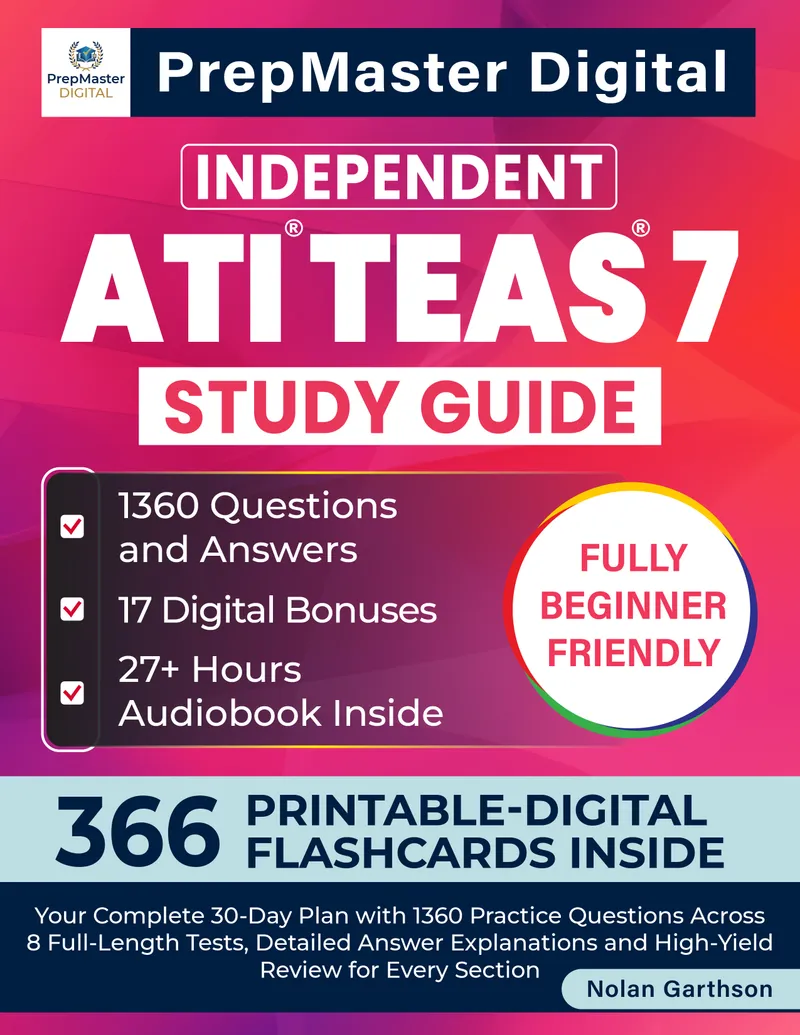
Independent ATI TEAS 7 Study Guide — Complete Digital Edition
Everything you need to raise the score this calculator just gave you: a 30-day plan, full-length practice tests with every answer explained, and review for all four sections.
- 1,360 practice questions in 8 full-length tests, each answer explained
- 366 flashcards and a ~27.7-hour audiobook for review on the go
- An AI tutor that answers from the guide's chapters (5 free questions)
- Instant digital access, yours to keep
- Retake Promise: didn't pass? The latest edition of everything, free, for your next attempt
🔒 Secure checkout by PayPro Global on prepmasterdigital.com · Retake Promise included
Prefer paper? Our TEAS books on Amazon: