The TEAS Reading section has 39 scored questions in 55 minutes, built on short passages like the ones below: explainers, opinion pieces, paired passages, a workplace memo, a clinic notice, a medication label and a household chart. The answer to every question is in the text — the explanations show where.
61 questions
Answers explained
No sign-up
TEAS 7 sub-areas: Key Ideas and Details (15 scored questions), Craft and Structure (9 scored questions), Integration of Knowledge and Ideas (15 scored questions). Click an answer to check it; the explanation opens below. Written by our team from our TEAS study guide and checked by a second reviewer — not real exam questions.
TEAS 7 Reading Practice0 / 61 answered
Read the passage, then answer the questions below
Most people think of sleep as a single block of rest, but the night is actually divided into repeating cycles. Each cycle lasts roughly ninety minutes and moves through lighter stages, a period of deep sleep, and a stage called REM sleep, named for the rapid eye movements that occur while a person dreams. Early in the night, cycles contain more deep sleep, which helps the body repair tissue and strengthen the immune system. Toward morning, REM periods grow longer, and these stages appear to help the brain sort and store memories from the day.
The timing of these cycles is guided by an internal clock that responds mainly to light. When evening light fades, the brain releases melatonin, a hormone that signals that it is time to rest. Bright screens late at night can delay that signal, pushing sleep later even when a person feels tired.
Because the stages serve different purposes, cutting a night short is not a minor loss. A person who wakes two hours early loses a large share of REM sleep, which may help explain why short sleepers often struggle to concentrate and recall details the next day.
Key Ideas and Details
Which statement best expresses the main idea of the passage?
Show answer & explanation
Correct answer: B. The passage explains that sleep moves through repeating cycles, that each stage serves a purpose, and that cutting the night short causes a real loss. The other statements either focus on one detail (screens, melatonin) or make a claim the passage never makes.Reference: Reading passage A (expository: sleep cycles)
Craft and Structure
As used in the first paragraph, the word "sort" most nearly means
Show answer & explanation
Correct answer: D. The brain is said to "sort and store" memories, which describes putting information in order so it can be kept. "Organize" fits this meaning; the other words would not make sense next to "store."Reference: Reading passage A (expository: sleep cycles)
Key Ideas and Details
Based on the passage, a student who scrolls on a bright phone late at night would most likely
Show answer & explanation
Correct answer: A. The passage states that bright screens late at night can delay the melatonin signal, pushing sleep later even when a person feels tired. The other choices contradict the passage or claim effects it never describes.Reference: Reading passage A (expository: sleep cycles)
Craft and Structure
How is the passage mainly organized?
Show answer & explanation
Correct answer: C. The first paragraph describes how sleep cycles work, the second explains the internal clock and light that control their timing, and the third explains what happens when sleep is cut short. There is no story, no competing theory and no list of solutions.Reference: Reading passage A (expository: sleep cycles)
Integration of Knowledge and Ideas
Which detail from the passage best supports the claim that waking up too early can affect memory?
Show answer & explanation
Correct answer: C. Waking early removes the last part of the night. Because REM periods are longest toward morning and are linked to storing memories, this detail connects early waking to memory. The other details are accurate but say nothing about memory.Reference: Reading passage A (expository: sleep cycles)
Read the passage, then answer the questions below
Give Students Time to Eat
At many schools, the lunch period is officially thirty minutes long, but students rarely get that much time at the table. By the time they walk from class, wash their hands, and wait in the serving line, some have barely ten minutes left to eat. That is not enough, and our district should change it.
When lunch is rushed, students make predictable choices. They grab the foods that are quickest to finish and leave behind the vegetables and fruit that take longer to eat. A cafeteria survey in our own district last spring found that trays returned on the busiest days held nearly twice as much uneaten produce as trays on lighter days. That is wasted food and wasted money.
Some board members argue that adding ten minutes to lunch would take time away from instruction. I understand the concern, but hungry students are not ready to learn. Afternoon teachers already report that many students are restless and distracted.
The fix is simple. Let us schedule lunch so that every student gets a full twenty minutes of seated eating time. Our students deserve a meal, not a race.
Craft and Structure
What is the author's main purpose in writing this passage?
Show answer & explanation
Correct answer: A. The author states a problem, says "our district should change it," answers an objection and ends with a specific proposal. These are features of persuasive writing. The survey is used as evidence, not described for its own sake.Reference: Reading passage B (persuasive: school lunch time)
Craft and Structure
Which sentence from the passage expresses an opinion rather than a fact?
Show answer & explanation
Correct answer: D. Whether students "deserve" something is a judgment that cannot be proved or disproved. The official length of the lunch period, what afternoon teachers report, and what board members argue can all be checked.Reference: Reading passage B (persuasive: school lunch time)
Integration of Knowledge and Ideas
Which statement best evaluates the evidence the author uses?
Show answer & explanation
Correct answer: B. The only measured evidence is the cafeteria survey, which compares uneaten produce on busy and lighter days. The claim that hungry students are not ready to learn is supported only by what afternoon teachers report. The passage mentions no other districts and no test scores.Reference: Reading passage B (persuasive: school lunch time)
Key Ideas and Details
According to the passage, what do students do when lunch is rushed?
Show answer & explanation
Correct answer: A. The second paragraph says that rushed students grab the quickest foods and leave behind the vegetables and fruit that take longer to eat. The other actions are not mentioned in the passage.Reference: Reading passage B (persuasive: school lunch time)
Craft and Structure
Which words best describe the author's tone?
Show answer & explanation
Correct answer: B. The author is worried about students eating too little (concerned) but offers a simple, specific fix (practical). The author treats the problem seriously, which rules out amused, casual, playful or lighthearted, and ends with a confident proposal while acknowledging the board members' concern, which rules out bitter and hopeless.Reference: Reading passage B (persuasive: school lunch time)
Read the passage, then answer the questions below
NOTICE TO PATIENTS: Riverside Family Clinic
Starting March 3, Riverside Family Clinic will use a new check-in process to shorten waiting times.
Before your visit, you will receive a text message with a link to an online form. Please complete the form at least 24 hours before your appointment. The form asks you to confirm your contact information, list your current medications, and upload a photo of the front and back of your insurance card.
When you arrive, go directly to the self-service kiosk to the left of the main entrance. Enter your date of birth and the last four digits of your phone number. The kiosk will print a numbered ticket. Take a seat and watch the screen above the reception desk; when your number appears, go to the window shown next to it.
If you did not complete the online form, you can still be seen. Select "I need help" on the kiosk screen, and a staff member will finish the form with you. Please allow 15 extra minutes for this.
Patients who need language assistance or a wheelchair may skip the kiosk and go straight to Window 1, where staff can also finish a missing form with them.
Key Ideas and Details
According to the notice, what should a patient do right after the kiosk prints a numbered ticket?
Show answer & explanation
Correct answer: D. The notice gives the order: enter your date of birth and phone digits, receive the printed ticket, then take a seat and watch the screen until your number appears. Entering the date of birth comes before the ticket, and the online form is completed before the visit.Reference: Reading passage C (clinic notice)
Key Ideas and Details
A patient who uses a wheelchair arrives without having completed the online form. Based on the notice, what is the most reasonable action?
Show answer & explanation
Correct answer: C. Patients who use a wheelchair may skip the kiosk and go to Window 1, where staff can also finish a missing form. The notice says finishing the form with staff takes about 15 extra minutes, so the patient should expect check-in to take longer. Nothing in the notice limits the Window 1 rule to patients who finished the form or asks anyone to go home or cancel.Reference: Reading passage C (clinic notice)
Integration of Knowledge and Ideas
A patient also receives this text message: "Riverside Family Clinic: Your visit is Thu 10:30 AM. Complete your check-in form by Wed 10:30 AM. Please arrive 10 minutes early." How does the text message relate to the notice?
Show answer & explanation
Correct answer: D. Wednesday 10:30 AM is exactly 24 hours before a Thursday 10:30 AM visit, which agrees with the notice. The request to arrive 10 minutes early appears only in the text message, so it adds new information without contradicting the notice.Reference: Reading passage C (clinic notice)
Integration of Knowledge and Ideas
Which detail from the notice best supports the clinic's claim that the new process will shorten waiting times?
Show answer & explanation
Correct answer: A. If information and insurance cards are handled before the visit, less work is left for the front desk when patients arrive, which shortens waits. The kiosk location and the Window 1 rule do not explain shorter waits, and the 15 extra minutes describes a longer check-in.Reference: Reading passage C (clinic notice)
Read the passage, then answer the questions below
Medication label (pain reliever and fever reducer, 200 mg tablets)
Directions: Adults and children 12 years and over: take 1 tablet every 4 to 6 hours while symptoms last. If pain or fever does not respond to 1 tablet, 2 tablets may be used. Do not take more than 6 tablets in 24 hours unless directed by a doctor. Children under 12 years: ask a doctor.
Warnings: Stop use and ask a doctor if pain gets worse or lasts more than 10 days, or if fever lasts more than 3 days. Take with food or milk if stomach upset occurs.
Key Ideas and Details
A 15-year-old took 2 tablets at 8:00 AM and 2 more tablets at 1:00 PM. Without a doctor's directions, how many more tablets can the teen take before 8:00 AM the next day?
Show answer & explanation
Correct answer: B. The label applies to anyone 12 or older and sets a limit of 6 tablets in 24 hours. The teen has already taken 2 + 2 = 4 tablets, so 6 - 4 = 2 tablets remain within the limit. Answering 6 ignores the tablets already taken.Reference: Reading informational item D (medication label)
Integration of Knowledge and Ideas
A handout found online says adults may take this medicine "up to 8 tablets a day if needed." Based on the label, how should a reader handle this difference?
Show answer & explanation
Correct answer: C. The label states "Do not take more than 6 tablets in 24 hours unless directed by a doctor," so a different limit requires a doctor's direction. The label also says a fever lasting more than 3 days is a reason to stop and call a doctor, not to take more.Reference: Reading informational item D (medication label)
Read the passage, then answer the questions below
Sleep and the Teenage Brain
Many parents wonder why their teenagers stay awake late at night and struggle to rise in the morning. The cause is not simply laziness. During adolescence, the body's internal clock shifts so that the brain releases the sleep hormone melatonin later in the evening than it does in childhood, often by as much as two hours. As a result, a teenager may not feel sleepy until close to midnight. Yet most high schools begin classes before 8:00 a.m., which forces many students to wake up well before their bodies are ready.
The effects of this mismatch add up. Teenagers need between eight and ten hours of sleep each night, but surveys show that most get fewer than eight on school days. Tired students have more trouble paying attention, are more likely to feel sad or irritable, and are more likely to doze off while driving. Some districts that moved their first bell to 8:30 a.m. or later reported that attendance rose and that fewer students arrived late.
Experts do not claim that a later start solves every problem. Students must still avoid bright screens before bed and keep a regular schedule. Even so, many sleep researchers argue that aligning school hours with teenage biology is a practical step that costs little.
Reading
Which statement best expresses the main idea of the passage?
Show answer & explanation
Correct answer: C. The passage says the cause 'is not simply laziness', that the body clock shifts, and that aligning school hours with teenage biology is a practical step. It also says a later start does not solve every problem.
Reading
According to the passage, by how much can melatonin release be delayed in adolescence compared with childhood?
Show answer & explanation
Correct answer: A. The passage says the brain releases melatonin later than in childhood, 'often by as much as two hours.'
Reading
According to the passage, what did some districts report after moving their first bell to 8:30 a.m. or later?
Show answer & explanation
Correct answer: D. The passage says these districts 'reported that attendance rose and that fewer students arrived late.' Test scores and screen habits are not mentioned.
Reading
A student must wake at 6:00 a.m. for school and does not fall asleep until midnight. Based on the passage, what can be inferred about this student?
Show answer & explanation
Correct answer: D. From midnight to 6:00 a.m. is six hours, but the passage says teenagers 'need between eight and ten hours of sleep each night.'
Reading
Why does the author write, 'Experts do not claim that a later start solves every problem'?
Show answer & explanation
Correct answer: C. The next sentence begins 'Even so, many sleep researchers argue...' and calls aligning school hours 'a practical step', so the earlier sentence admits a limit before restating the proposal's value.
Read the passage, then answer the questions below
Life in a Tide Pool
A tide pool forms when seawater is left behind in a rocky hollow after the tide goes out. Though small, these pools are harsh places to live. Within a single day, the water may warm in the sun, grow saltier as it evaporates, and then be flooded with cool ocean water when the tide returns. Rain can also dilute the salt in the pool. Animals that live here must tolerate rapid changes that would kill most sea creatures.
Sea anemones are one example. When exposed to air, an anemone pulls in its tentacles and looks like a lump of jelly, which helps it keep moisture inside. Mussels close their shells tightly and hold water within until the sea returns. Hermit crabs, in contrast, simply move: they scuttle from a shrinking pool to a deeper one.
Scientists study tide pools because the pools show clearly how living things respond to stress. A pool can be observed from edge to edge in a few minutes, and a change in temperature or salt level can be measured directly. Researchers also note that tide pools often host more species than the open rock around them. Visitors who explore the pools should step carefully, since a single footstep can crush animals that took months to grow.
Reading
Which statement best expresses the main idea of the passage?
Show answer & explanation
Correct answer: A. The passage opens by calling tide pools 'harsh places to live' with 'rapid changes', then describes how anemones, mussels and hermit crabs each cope.
Reading
According to the passage, which event can make the water in a tide pool saltier?
Show answer & explanation
Correct answer: D. The passage says the water may 'grow saltier as it evaporates'. It adds that rain 'can also dilute the salt', so rain has the opposite effect.
Reading
How is the second paragraph organized?
Show answer & explanation
Correct answer: B. The paragraph describes sea anemones, mussels and hermit crabs one after another and what each does when conditions change.
Reading
How does the hermit crab's response differ from the responses of the anemone and the mussel?
Show answer & explanation
Correct answer: C. The passage says the anemone pulls in its tentacles and the mussel closes its shell, but hermit crabs 'simply move: they scuttle from a shrinking pool to a deeper one.'
Reading
According to the passage, why do scientists study tide pools?
Show answer & explanation
Correct answer: A. The passage says 'the pools show clearly how living things respond to stress' and that a pool 'can be observed from edge to edge in a few minutes.'
Read the passage, then answer the questions below
Flu Vaccinations at Riverside Health Clinic
Riverside Health Clinic recorded the number of flu vaccinations it gave during four weeks in October. The numbers are shown below.
Week 1 (Oct. 1-7): 42 adults, 18 children, 60 total
Week 2 (Oct. 8-14): 55 adults, 31 children, 86 total
Week 3 (Oct. 15-21): 68 adults, 47 children, 115 total
Week 4 (Oct. 22-28): 51 adults, 29 children, 80 total
Clinic staff noted that Week 3 included a free vaccination day for school-aged children, held on Saturday, October 18. The clinic is open Monday through Saturday. Staff also reminded visitors that a flu vaccine should be received every year, because the viruses that cause flu change from one season to the next. Appointments are recommended but are not required for adults or children.
Reading
According to the information given, how many flu vaccinations did the clinic give during the four weeks?
Show answer & explanation
Correct answer: B. Adding the weekly totals: 60 + 86 + 115 + 80 = 341.
Reading
Compared with the week before, in which week did the number of children vaccinated increase the most?
Show answer & explanation
Correct answer: C. Children rose from 18 to 31 (+13) in Week 2 and from 31 to 47 (+16) in Week 3. In Week 4 the number fell from 47 to 29.
Reading
Which detail from the passage best explains why more children were vaccinated in Week 3?
Show answer & explanation
Correct answer: A. The passage says 'Week 3 included a free vaccination day for school-aged children.' Every week listed covers the same seven days, so a longer week does not explain it.
Reading
Which statement is supported by the information in the passage?
Show answer & explanation
Correct answer: D. Adults numbered 42, 55, 68 and 51, so Week 3 (68) was highest. The other statements are false: adults outnumbered children every week, the total fell in Week 4 (80), and Week 3 had 115.
Read the passage, then answer the questions below
The Alvarez Family's Electricity Use
The Alvarez family compared their electricity use for one month, listed below by appliance. Electricity use is measured in kilowatt-hours (kWh).
Water heater: 120 kWh
Clothes dryer: 60 kWh
Refrigerator: 45 kWh
Lighting: 30 kWh
Television and computers: 25 kWh
Other: 20 kWh
The family wanted to lower its bill without giving up any appliance. After replacing all of their light bulbs with a more efficient type, the family's lighting use the next month fell to 10 kWh. All other use stayed exactly the same as in the first month. The family plans to look next at the water heater, since it uses more electricity than any other item on the list. The family keeps a notebook of its monthly readings so that it can see whether each change makes a difference.
Reading
What was the family's total electricity use in the first month?
What was the family's total electricity use in the second month?
Show answer & explanation
Correct answer: D. Only lighting changed, falling from 30 to 10 kWh, which is 20 kWh less. 300 - 20 = 280 kWh.
Reading
What percent of the first month's total electricity use was used by the water heater?
Show answer & explanation
Correct answer: A. The water heater used 120 of 300 kWh. 120 / 300 = 0.40, or 40%.
Reading
By what fraction did the family's lighting use drop after the new bulbs were installed?
Show answer & explanation
Correct answer: C. Lighting fell from 30 kWh to 10 kWh, a drop of 20 kWh. 20 / 30 = two-thirds.
Read the passage, then answer the questions below
The Four-Day Week (Passage 1 and Passage 2)
Passage 1: A Case for the Four-Day Week
Companies should consider a four-day work week with the same pay. In a trial at a mid-sized software firm, employees worked 32 hours instead of 40 for six months. Output stayed steady, and the number of sick days taken fell by nearly a third. Workers reported less stress and said they were more focused during the hours they did work. Because employees were eager to protect their extra day off, they cut back on long meetings and unnecessary tasks. The firm also found it easier to hire, since job seekers viewed the shorter week as a valuable benefit. Managers who had expected chaos were surprised by how smoothly the schedule ran. A shorter week, in short, can make a business more productive, not less.
Passage 2: Cautions About the Four-Day Week
A four-day week sounds appealing, but it will not suit every business. The software firm's trial involved work that can be done at a desk and paused overnight. A hospital, a restaurant, or a repair shop must be staffed on certain days, and cutting each worker's hours could leave gaps in service or require hiring more people. Those added wages could erase any savings. Customers, too, expect to reach businesses on regular days. In addition, a six-month trial may not show long-term results; workers may be energetic at first simply because the arrangement is new. Small teams that rely on face-to-face help during the week may also find that a missing day makes coordination harder. Employers should test shorter weeks carefully, department by department, before changing policy for everyone.
Reading
Both passages refer to which of the following?
Show answer & explanation
Correct answer: D. Passage 1 describes 'a trial at a mid-sized software firm', and Passage 2 begins its argument with 'The software firm's trial'. Passage 2 mentions hospitals only as an example of a type of business.
Reading
Which statement best describes how the two passages differ?
Show answer & explanation
Correct answer: B. Passage 1 ends with 'a shorter week... can make a business more productive'; Passage 2 opens with 'it will not suit every business.'
Reading
How would the writer of Passage 2 most likely respond to the statement in Passage 1 that workers were more focused during the trial?
Show answer & explanation
Correct answer: C. Passage 2 says 'workers may be energetic at first simply because the arrangement is new.'
Reading
Why does the writer of Passage 2 mention a hospital, a restaurant, and a repair shop?
Show answer & explanation
Correct answer: A. The passage says these businesses 'must be staffed on certain days', so cutting hours could leave gaps in service.
Reading
Which sentence from Passage 1 is best described as the writer's recommendation rather than a reported result?
Show answer & explanation
Correct answer: B. 'Should consider' states what the writer thinks companies ought to do. The other three sentences report what happened during the trial.
Read the passage, then answer the questions below
Paper Books and E-readers (Passage 1 and Passage 2)
Passage 1: Why I Still Buy Paper Books
I own a tablet that can hold hundreds of books, yet I keep buying paper ones. When I read a printed book, I always know roughly where I am: a quarter of the way through, near the end of a chapter, at the bottom of a left-hand page. That physical sense helps me remember where an idea appeared when I want to find it again. A paper book also has no notifications to pull my attention away. Several studies, including one with high school students, have suggested that readers recall slightly more of a story when they read it on paper. A book never runs out of battery on a long trip, and I also enjoy lending a favorite novel to a friend. For these reasons, paper remains my first choice.
Passage 2: The Case for E-readers
E-readers have changed how I read for the better. My device weighs less than a single hardback, yet it carries my whole library, which matters on a long commute. I can raise the text size when my eyes are tired and turn on a light to read in a dark room without waking my family. If I meet an unfamiliar word, I can tap it and see a definition at once. Digital copies are often cheaper than printed ones, and a borrowed library title returns itself when the loan ends, so I never pay late fees. A single e-reader also saves shelf space, which is useful in a small apartment. I admit that paper has a certain charm, but the practical advantages of an e-reader are hard to ignore.
Reading
Which statement best compares the two passages?
Show answer & explanation
Correct answer: D. Passage 1 cites recall, no notifications and a sense of place in paper books; Passage 2 cites weight, text size, built-in definitions and cost.
Reading
Which advantage is mentioned in Passage 2 but not in Passage 1?
Show answer & explanation
Correct answer: A. Passage 2 says 'I can raise the text size when my eyes are tired.' The other three points all appear in Passage 1.
Reading
How does the writer of Passage 1 support the claim that readers recall slightly more of a story on paper?
Show answer & explanation
Correct answer: C. Passage 1 says 'Several studies, including one with high school students, have suggested' this result.
Reading
Why does the writer of Passage 2 say, 'I admit that paper has a certain charm'?
Show answer & explanation
Correct answer: D. The sentence continues 'but the practical advantages of an e-reader are hard to ignore', so the writer concedes a point and then returns to the main argument.
Reading
Based on Passage 2, which reader would the writer most likely recommend an e-reader to?
Show answer & explanation
Correct answer: B. Passage 2 praises the e-reader for carrying a whole library on a commute and for adjustable text size when the eyes are tired.
Read the passage, then answer the questions below
The Library Company of Philadelphia
In 1731, a young printer in Philadelphia named Benjamin Franklin helped found the Library Company, one of the first lending libraries supported by members in the American colonies. At the time, books were expensive and had to be shipped across the Atlantic, so few ordinary people owned more than a handful. Franklin proposed that a group of members each pay an entry fee and a small yearly amount, and that the money be used to buy books that everyone in the group could borrow.
The idea worked. The members were able to afford far more titles together than any of them could have bought alone. Over time, the collection grew to include works on science, history, and law. Later, towns and states began to fund libraries with public money, so that people no longer needed to pay a membership fee.
Historians often point to subscription libraries like this one as an early step toward the free public library. They showed that sharing resources could give a community access to knowledge that individuals could not afford on their own.
Reading
Which statement best expresses the main idea of the passage?
Show answer & explanation
Correct answer: A. The passage ends that subscription libraries like this one were 'an early step toward the free public library.' It calls the Library Company only 'one of the first' lending libraries in the colonies.
Reading
According to the passage, why did few ordinary people own many books in 1731?
Show answer & explanation
Correct answer: C. The passage says 'books were expensive and had to be shipped across the Atlantic, so few ordinary people owned more than a handful.'
Reading
According to the passage, how were members able to afford more titles than any one of them could buy alone?
Show answer & explanation
Correct answer: B. Members 'each pay an entry fee and a small yearly amount', and 'the money be used to buy books'. Public funding came 'later'.
Reading
Which conclusion is best supported by the passage?
Show answer & explanation
Correct answer: D. The passage says 'Later, towns and states began to fund libraries with public money', after the members' library was founded in 1731.
Reading
As used in the passage, the word 'handful' most nearly means
Show answer & explanation
Correct answer: A. The sentence says books were expensive, 'so few ordinary people owned more than a handful', meaning only a small number.
Read the passage, then answer the questions below
Memo: New Shift Check-In Procedure
To: All Warehouse Staff
From: Dana Whitfield, Operations Manager
Subject: New Shift Check-In Procedure
Beginning Monday, March 3, every employee must scan a badge at the east entrance before starting a shift. The scanners will replace the paper sign-in sheets that have been used until now. This change will make pay records more accurate and will help us know who is in the building during an emergency.
Please bring your badge each day. If you forget it, see the front desk supervisor, who can issue a one-day pass. Employees who have not received a badge should stop by the office before Friday, February 28. Supervisors will review attendance reports each Friday, so please make sure you scan both when you arrive and when you leave.
Thank you for your cooperation. If you have questions, please call extension 214.
Reading
What is the main purpose of the memo?
Show answer & explanation
Correct answer: C. The memo begins 'every employee must scan a badge' and then explains what to do about forgotten or missing badges.
Reading
According to the memo, what should an employee do if he or she forgets a badge?
Show answer & explanation
Correct answer: D. The memo says 'If you forget it, see the front desk supervisor, who can issue a one-day pass.' The paper sheets are being replaced.
Reading
Before what date should employees who have not received a badge stop by the office?
Show answer & explanation
Correct answer: B. The memo says 'Employees who have not received a badge should stop by the office before Friday, February 28.'
Reading
According to the memo, which is one reason for the change?
Show answer & explanation
Correct answer: A. The memo says the change 'will help us know who is in the building during an emergency.'
Reading
Which phrase best describes the tone of the memo?
Show answer & explanation
Correct answer: C. The memo gives clear directions ('Please bring your badge each day') in polite, businesslike language.
Reading
A medicine label reads: 'Take 1 tablet every 8 hours with food. Do not take more than 3 tablets in 24 hours.' A patient takes the first tablet at 7:00 a.m. Which set of times for the next two tablets follows the label?
Show answer & explanation
Correct answer: B. Eight hours after 7:00 a.m. is 3:00 p.m., and eight hours after that is 11:00 p.m. The other choices are spaced 4, 6 and 7 hours apart.
Reading
A bus leaves Maple Station at 6:40, 7:10, 7:40 and 8:10 a.m. The ride to the Central Library takes 25 minutes. Maya must be at the library by 8:00 a.m. What is the latest bus she can take?
Show answer & explanation
Correct answer: B. The 7:10 bus arrives at 7:35. The 7:40 bus arrives at 8:05, which is too late, and the 8:10 bus is later still.
Reading
Which of the following sentences states a fact that could be checked?
Show answer & explanation
Correct answer: A. The opening month and length can be verified. 'Most beautiful', 'should', and 'waste of money' are opinions.
Reading
A set of instructions for cleaning a filter says: '1. Unplug the device. 2. Remove the filter. 3. Rinse it under cold water for 30 seconds. 4. Let it dry completely for at least 2 hours. 5. Replace the filter and plug in the device.' According to the instructions, what must happen before the filter is put back?
Show answer & explanation
Correct answer: C. Step 4 comes directly before the filter is replaced in step 5 and requires drying for at least 2 hours. Step 3 calls for cold water for 30 seconds, and the device is unplugged first.
Reading
A student wants to find the recommended daily amount of vitamin D for adults. Which source is most likely to be reliable?
Show answer & explanation
Correct answer: B. A health agency exists to give public health guidance. A blog, a seller's post, and an ad may be mistaken or aimed at selling a product.
Reading
Read the sentence: 'The scientist's explanation was so lucid that even the newest student could follow every step.' As used in the sentence, the word 'lucid' most nearly means
Show answer & explanation
Correct answer: D. The clause 'even the newest student could follow every step' shows the explanation was easy to understand, which means clear.
Reading
Read the text: 'Before you sign a gym contract, read every line. Ask about cancellation fees, and compare at least three gyms. Your wallet will thank you.' What is the author's main purpose?
Show answer & explanation
Correct answer: A. The text gives commands ('read every line', 'compare at least three gyms') meant to convince readers to act carefully.
0%
Your score by section. Answers you skipped count as wrong.
Official facts — verified on November 7, 2026 by the Prep Master Digital editorial team. Rules change: always confirm on the official pages before your exam.
References used in the explanations: Reading informational item D (medication label).
From Prep Master Digital
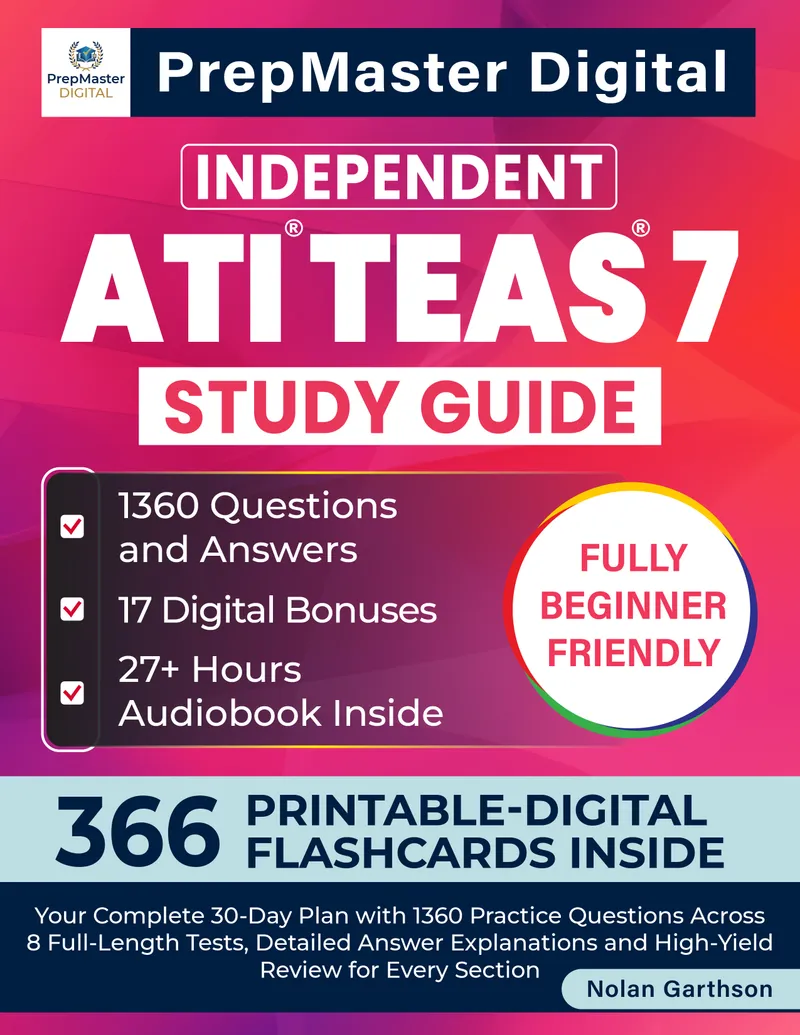
Independent ATI TEAS 7 Study Guide — Complete Digital Edition
Everything you need to raise the score this calculator just gave you: a 30-day plan, full-length practice tests with every answer explained, and review for all four sections.
1,360 practice questions in 8 full-length tests, each answer explained
366 flashcards and a ~27.7-hour audiobook for review on the go
An AI tutor that answers from the guide's chapters (5 free questions)
Instant digital access, yours to keep
Retake Promise: didn't pass? The latest edition of everything, free, for your next attempt