Chemistry is worth 8 scored questions on the TEAS — few, but they are the ones many nursing applicants skip. These 16 questions cover everything ATI lists for the sub-area, with six small calculations like the exam's.
16 questions
Answers explained
No sign-up
TEAS 7 sub-area: Chemistry (8 scored questions). Click an answer to check it; the explanation opens below. Written by our team from our TEAS study guide and checked by a second reviewer — not real exam questions.
TEAS Chemistry Practice0 / 16 answered
Chemistry
Chlorine has an atomic number of 17. How many neutrons are in the nucleus of a chlorine-37 atom?
Show answer & explanation
Correct answer: C. The mass number (37) is the total of protons and neutrons, and the atomic number (17) is the number of protons, so neutrons = 37 − 17 = 20. Choosing 17 confuses neutrons with protons, and 54 wrongly adds the two numbers.Reference: OpenStax Chemistry 2e, ch. 2 (Atoms, Molecules, and Ions)
Chemistry
Carbon-12 and carbon-14 are both isotopes of carbon. What is different between atoms of these two isotopes?
Show answer & explanation
Correct answer: A. Isotopes of an element have the same number of protons (6 for carbon) but different numbers of neutrons: carbon-12 has 6 and carbon-14 has 8. If the number of protons changed, the atom would become a different element, so protons cannot be the difference.Reference: OpenStax Chemistry 2e, ch. 2 (Atoms, Molecules, and Ions)
Chemistry
Calcium has an atomic number of 20. How many electrons does a calcium ion, Ca²⁺, have?
Show answer & explanation
Correct answer: D. A neutral calcium atom has 20 protons and 20 electrons. The 2+ charge means it has lost two electrons, leaving 20 − 2 = 18. Choosing 22 is a common sign error: a positive ion has fewer electrons than protons, not more.Reference: OpenStax Chemistry 2e, ch. 2 (Atoms, Molecules, and Ions)
Chemistry
Moving from left to right across period 3, from sodium to chlorine, how does electronegativity generally change, and why?
Show answer & explanation
Correct answer: B. Across a period, each element adds one proton while its valence electrons stay in the same energy level, so the nucleus pulls more strongly on bonding electrons and electronegativity increases. Adding electron shells happens going down a group, which is why electronegativity decreases down a group, not across a period.Reference: OpenStax Chemistry 2e, ch. 7 (Chemical Bonding and Molecular Geometry)
Chemistry
Which pair of elements is most likely to form an ionic compound?
Show answer & explanation
Correct answer: D. Ionic bonds usually form between a metal and a nonmetal: magnesium gives up two electrons and oxygen gains them, forming Mg²⁺ and O²⁻ in MgO. Carbon and oxygen are both nonmetals, so they share electrons in polar covalent bonds rather than transferring them.Reference: OpenStax Chemistry 2e, ch. 7 (Chemical Bonding and Molecular Geometry)
Chemistry
Both water (H₂O) and carbon dioxide (CO₂) contain polar bonds, yet water is a polar molecule and carbon dioxide is not. What explains the difference?
Show answer & explanation
Correct answer: C. Polarity depends on both bond polarity and shape. CO₂ is linear, so its two equal bond dipoles point in opposite directions and cancel; water is bent, so its dipoles add up to a net dipole. Water's O–H bonds are polar covalent, not ionic, so the first option is wrong.Reference: OpenStax Chemistry 2e, ch. 7 (Chemical Bonding and Molecular Geometry)
Chemistry
Aluminum reacts with oxygen to form aluminum oxide: __Al + __O₂ → __Al₂O₃. When the equation is balanced with the smallest whole-number coefficients, what is the coefficient of Al?
Show answer & explanation
Correct answer: A. Oxygen must match first: 3 O₂ gives 6 O atoms, which requires 2 Al₂O₃. Those 2 units contain 4 Al atoms, so the balanced equation is 4Al + 3O₂ → 2Al₂O₃. The numbers 2 and 3 appear in the balanced equation, but they belong to Al₂O₃ and O₂, not to Al.Reference: OpenStax Chemistry 2e, ch. 4 (Stoichiometry of Chemical Reactions)
Chemistry
Zinc metal is dropped into hydrochloric acid: Zn + 2HCl → ZnCl₂ + H₂. Which type of reaction is this?
Show answer & explanation
Correct answer: B. A single element (zinc) replaces another element (hydrogen) in a compound, following the pattern A + BC → AC + B. In a double replacement reaction, two compounds swap partners (AB + CD → AD + CB), but here only one of the reactants is a compound.Reference: OpenStax Chemistry 2e, ch. 4 (Stoichiometry of Chemical Reactions)
Chemistry
A solution's pH changes from 3 to 5. How has its hydrogen ion (H⁺) concentration changed?
Show answer & explanation
Correct answer: B. The pH scale is logarithmic: each 1-unit rise in pH means a tenfold drop in H⁺ concentration. A rise of 2 units means 10 × 10 = 100 times less H⁺ (from 10⁻³ M to 10⁻⁵ M). A factor of 2 would wrongly treat the pH scale as linear.Reference: OpenStax Chemistry 2e, ch. 14 (Acid-Base Equilibria)
Chemistry
In the reaction NH₃ + H₂O ⇌ NH₄⁺ + OH⁻, which reactant acts as the Brønsted–Lowry acid?
Show answer & explanation
Correct answer: D. A Brønsted–Lowry acid donates a proton (H⁺). Water gives a proton to ammonia and becomes OH⁻, so water is the acid and ammonia is the base. NH₄⁺ is tempting because it contains the extra proton, but it is the conjugate acid formed on the product side, not a reactant.Reference: OpenStax Chemistry 2e, ch. 14 (Acid-Base Equilibria)
Chemistry
How many grams of sodium chloride are needed to prepare 500 mL of a 0.20 M NaCl solution? (Molar mass of NaCl = 58.5 g/mol)
Show answer & explanation
Correct answer: A. Moles = molarity × liters = 0.20 mol/L × 0.500 L = 0.10 mol. Mass = 0.10 mol × 58.5 g/mol = 5.85 g. The answer 11.7 g comes from using 1 L of solution instead of 0.500 L, and 2.93 g comes from halving the correct amount a second time.Reference: OpenStax Chemistry 2e, ch. 3 (Composition of Substances and Solutions)
Chemistry
A technician adds water to 50 mL of a 6% saline solution until the total volume is 300 mL. What is the concentration of the diluted solution?
Show answer & explanation
Correct answer: C. Use the dilution formula C₁V₁ = C₂V₂: (6%)(50 mL) = C₂(300 mL), so C₂ = 300 ÷ 300 = 1%. The amount of solute stays the same while the volume grows six times, so the concentration falls to one sixth. Answering 2% or 3% underestimates how much the volume increased.Reference: OpenStax Chemistry 2e, ch. 3 (Composition of Substances and Solutions)
Chemistry
On a cold winter morning, frost forms on a car window directly from water vapor in the air, without first becoming liquid. What is this phase change called?
Show answer & explanation
Correct answer: A. Deposition is the change from gas directly to solid. Sublimation is the reverse process, solid directly to gas, so it is the most tempting wrong answer. Condensation (gas to liquid) and freezing (liquid to solid) both involve a liquid stage, which frost skips.Reference: OpenStax Chemistry 2e, ch. 10 (Liquids and Solids)
Chemistry
Heat is added steadily to a beaker of ice at 0 °C, but the thermometer stays at 0 °C until all the ice has melted. Where is the added energy going?
Show answer & explanation
Correct answer: B. During melting, the added heat (heat of fusion) goes into overcoming the hydrogen bonds and other attractions between molecules, not into raising their average kinetic energy, so temperature stays constant. The covalent O–H bonds inside each molecule stay intact; breaking them would be a chemical change, not a phase change.Reference: OpenStax Chemistry 2e, ch. 10 (Liquids and Solids)
Chemistry
Water has an unusually high specific heat, which helps the human body resist rapid changes in temperature. Which feature of water is mainly responsible?
Show answer & explanation
Correct answer: D. Much of the heat added to water goes into breaking hydrogen bonds between neighboring molecules before the molecules can move faster, so water absorbs a lot of heat for a small rise in temperature. The O–H bonds within a water molecule are polar covalent, not nonpolar and not ionic.Reference: OpenStax Chemistry 2e, ch. 10 (Liquids and Solids)
Chemistry
Enzymes allow reactions in the body to occur quickly at normal body temperature. How does an enzyme, acting as a catalyst, speed up a reaction?
Show answer & explanation
Correct answer: C. A catalyst provides an alternative reaction pathway with a lower activation energy, so more molecules have enough energy to react at the same temperature. A catalyst is not consumed, and it speeds up the forward and reverse reactions equally, so it does not shift the equilibrium position.Reference: OpenStax Chemistry 2e, ch. 12 (Kinetics)
0%
Your score by section. Answers you skipped count as wrong.
Official facts — verified on November 7, 2026 by the Prep Master Digital editorial team. Rules change: always confirm on the official pages before your exam.
References used in the explanations: OpenStax Chemistry 2e, ch. 10 (Liquids and Solids); OpenStax Chemistry 2e, ch. 12 (Kinetics); OpenStax Chemistry 2e, ch. 14 (Acid-Base Equilibria); OpenStax Chemistry 2e, ch. 2 (Atoms, Molecules, and Ions); OpenStax Chemistry 2e, ch. 3 (Composition of Substances and Solutions); OpenStax Chemistry 2e, ch. 4 (Stoichiometry of Chemical Reactions); OpenStax Chemistry 2e, ch. 7 (Chemical Bonding and Molecular Geometry).
From Prep Master Digital
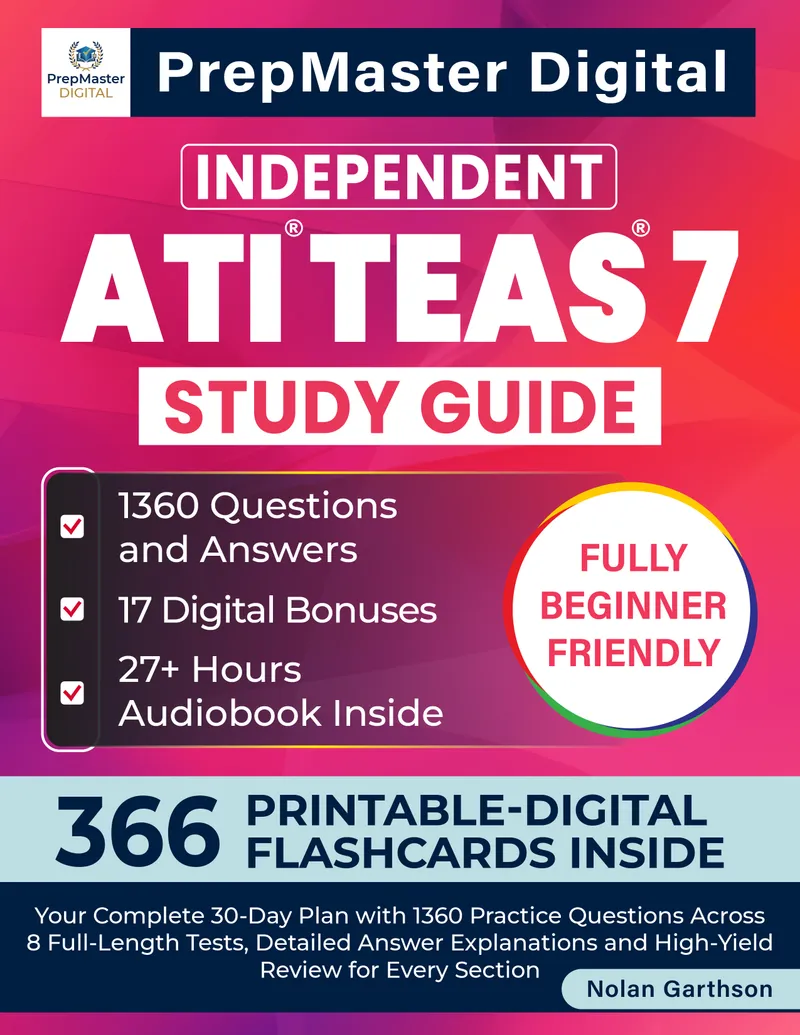
Independent ATI TEAS 7 Study Guide — Complete Digital Edition
Everything you need to raise the score this calculator just gave you: a 30-day plan, full-length practice tests with every answer explained, and review for all four sections.
1,360 practice questions in 8 full-length tests, each answer explained
366 flashcards and a ~27.7-hour audiobook for review on the go
An AI tutor that answers from the guide's chapters (5 free questions)
Instant digital access, yours to keep
Retake Promise: didn't pass? The latest edition of everything, free, for your next attempt