Human Anatomy and Physiology is the biggest sub-area of the TEAS Science section: 18 of the 44 scored Science questions, more than Biology, Chemistry and Scientific Reasoning. These 16 questions cover ten body systems at the level of the real exam.
16 questions
Answers explained
No sign-up
TEAS 7 sub-area: Human Anatomy and Physiology (18 scored questions). Click an answer to check it; the explanation opens below. Written by our team from our TEAS study guide and checked by a second reviewer — not real exam questions.
TEAS Anatomy and Physiology Practice0 / 16 answered
Human Anatomy and Physiology
A blood clot forms in a deep vein of a patient's left calf and breaks loose. If the patient has no heart defects, where is the clot most likely to lodge first?
Show answer & explanation
Correct answer: B. Venous blood from the leg returns through the inferior vena cava to the right atrium and right ventricle, which pump it into the pulmonary arteries. The lung capillaries are the first narrow vessels the clot meets, so it becomes a pulmonary embolism. The brain, heart muscle, and kidneys receive blood only after it has passed through the lungs and the left side of the heart.Reference: OpenStax Anatomy and Physiology 2e, ch. 20 (The Cardiovascular System: Blood Vessels and Circulation)
Human Anatomy and Physiology
A patient's sinoatrial (SA) node stops firing, and the monitor now shows a steady rhythm of about 45 beats per minute. Which structure has most likely taken over as the pacemaker?
Show answer & explanation
Correct answer: D. When the SA node fails, the atrioventricular (AV) node, the next fastest pacemaker tissue, usually takes over at an intrinsic rate of about 40 to 60 beats per minute. Purkinje fibers can also pace the heart, but their intrinsic rate is slower, about 20 to 40 beats per minute, so 45 beats per minute fits the AV node.Reference: OpenStax Anatomy and Physiology 2e, ch. 19 (The Cardiovascular System: The Heart)
Human Anatomy and Physiology
Which event allows air to flow into the lungs during quiet, resting inspiration?
Show answer & explanation
Correct answer: A. When the diaphragm contracts it flattens and moves down, increasing thoracic volume; by Boyle's law, pressure in the lungs drops below atmospheric pressure and air flows in. Relaxation of the diaphragm reduces chest volume and is what drives quiet expiration, not inspiration.Reference: OpenStax Anatomy and Physiology 2e, ch. 22 (The Respiratory System)
Human Anatomy and Physiology
A long-time smoker is diagnosed with emphysema, in which the walls between alveoli are destroyed. Which change most directly explains the patient's low blood oxygen?
Show answer & explanation
Correct answer: C. Gas exchange happens by diffusion across the thin alveolar walls, and the rate of diffusion depends on surface area. When alveolar walls break down, small sacs merge into fewer large ones, so the total surface area drops and less oxygen enters the blood. Destruction of alveoli reduces, not increases, the area for diffusion.Reference: OpenStax Anatomy and Physiology 2e, ch. 22 (The Respiratory System)
Human Anatomy and Physiology
After having her gallbladder removed, a patient is told that large, high-fat meals may cause discomfort. Which function did the gallbladder perform?
Show answer & explanation
Correct answer: C. The liver produces bile; the gallbladder stores and concentrates it, then releases a large amount into the duodenum when fatty food arrives. Without the gallbladder, bile trickles in continuously, so a big fatty meal may not be emulsified well. Producing bile is a tempting choice, but that is the liver's job, which continues after surgery.Reference: OpenStax Anatomy and Physiology 2e, ch. 23 (The Digestive System)
Human Anatomy and Physiology
A patient takes a medication that strongly reduces stomach acid production. Activation of which digestive enzyme is most directly impaired?
Show answer & explanation
Correct answer: A. Chief cells secrete inactive pepsinogen, and hydrochloric acid from parietal cells converts it into pepsin, which begins protein digestion in the stomach. Pancreatic lipase works in the more alkaline duodenum and does not need stomach acid to become active.Reference: OpenStax Anatomy and Physiology 2e, ch. 23 (The Digestive System)
Human Anatomy and Physiology
A cook touches a hot pan and jerks the hand away a split second before feeling any pain. Which best describes this response?
Show answer & explanation
Correct answer: D. The withdrawal reflex travels from sensory receptors to the spinal cord, through interneurons, and directly out to motor neurons, without waiting for the brain. Pain is felt slightly later because the signal must also ascend to the cerebral cortex. A voluntary cortical command would be slower and would follow conscious awareness of the pain.Reference: OpenStax Anatomy and Physiology 2e, ch. 14 (The Somatic Nervous System)
Human Anatomy and Physiology
What happens at a neuron's membrane during the depolarization phase of an action potential?
Show answer & explanation
Correct answer: B. When threshold is reached, voltage-gated sodium channels open and Na⁺ flows into the cell, making the inside more positive. Potassium does move through voltage-gated channels, but it flows out of the cell during repolarization, not in during depolarization.Reference: OpenStax Anatomy and Physiology 2e, ch. 12 (The Nervous System and Nervous Tissue)
Human Anatomy and Physiology
A teenager with type 1 diabetes forgets an insulin dose before dinner. What happens to blood glucose, and why?
Show answer & explanation
Correct answer: A. Insulin lets muscle and fat cells take up glucose and promotes glycogen storage. Without it, glucose stays in the blood and levels rise. In type 1 diabetes the beta cells of the pancreas are destroyed, so the pancreas cannot respond by releasing extra insulin.Reference: OpenStax Anatomy and Physiology 2e, ch. 17 (The Endocrine System)
Human Anatomy and Physiology
A patient's thyroid gland is damaged and produces too little T₃ and T₄. Through negative feedback, how is the level of thyroid-stimulating hormone (TSH) expected to change?
Show answer & explanation
Correct answer: C. T₃ and T₄ normally inhibit the hypothalamus and anterior pituitary. When their levels drop, that inhibition is lost, so TRH and TSH secretion increase in an attempt to stimulate the thyroid. A high TSH with low thyroid hormone is the classic pattern of primary hypothyroidism, so TSH does not fall.Reference: OpenStax Anatomy and Physiology 2e, ch. 17 (The Endocrine System)
Human Anatomy and Physiology
During a biceps curl, the muscle fibers of the biceps shorten. At the molecular level, what directly causes each sarcomere to shorten?
Show answer & explanation
Correct answer: B. In the sliding filament model, myosin heads bind actin, pivot in a power stroke, and pull the thin filaments toward the M line, so the filaments overlap more but do not change length. Calcium is required, but it binds troponin, which moves tropomyosin off the binding sites; it does not bind myosin.Reference: OpenStax Anatomy and Physiology 2e, ch. 10 (Muscle Tissue)
Human Anatomy and Physiology
When blood calcium drops, parathyroid hormone (PTH) increases. Which bone cells does PTH stimulate, indirectly, to break down bone matrix and release calcium into the blood?
Show answer & explanation
Correct answer: D. Osteoclasts are large cells that resorb bone matrix, releasing calcium and phosphate into the blood; PTH increases their activity. Osteoblasts are the tempting wrong answer: they build new matrix and deposit calcium into bone, which would lower blood calcium.Reference: OpenStax Anatomy and Physiology 2e, ch. 6 (Bone Tissue and the Skeletal System)
Human Anatomy and Physiology
Before a trip, a traveler receives an injection of immune globulin, which contains ready-made antibodies against hepatitis A. What type of immunity does this provide?
Show answer & explanation
Correct answer: D. The traveler receives antibodies made by someone else through a medical procedure, so the immunity is artificial and passive. It works right away but fades within weeks to months because no memory cells form. Artificial active immunity comes from a vaccine, which makes the person's own immune system produce antibodies.Reference: OpenStax Anatomy and Physiology 2e, ch. 21 (The Lymphatic and Immune System)
Human Anatomy and Physiology
A urinalysis shows large amounts of protein and red blood cells in a patient's urine. Damage to which part of the nephron is most likely?
Show answer & explanation
Correct answer: B. The glomerular filtration membrane normally lets water and small solutes pass while holding back blood cells and most plasma proteins. When the glomerulus is damaged, these large components leak into the filtrate and appear in urine. The tubules, such as the loop of Henle, adjust water and salt after filtration and do not decide what is filtered.Reference: OpenStax Anatomy and Physiology 2e, ch. 25 (The Urinary System)
Human Anatomy and Physiology
In a typical 28-day ovarian cycle, which hormonal event directly triggers ovulation around day 14?
Show answer & explanation
Correct answer: C. High estrogen from the maturing follicle causes the anterior pituitary to release a surge of luteinizing hormone (LH), and this LH surge causes the follicle to rupture and release the oocyte. Estrogen sets up the surge but is not the direct trigger, and it comes from the follicle, not the endometrium.Reference: OpenStax Anatomy and Physiology 2e, ch. 27 (The Reproductive System)
Human Anatomy and Physiology
A patient spilled boiling water on the forearm. The burn is red, blistered, and very painful, and it involves the epidermis and part of the dermis. How is this burn classified?
Show answer & explanation
Correct answer: A. A partial-thickness burn damages the epidermis and part of the dermis, producing blisters and marked pain because nerve endings are still present. A full-thickness burn destroys the whole dermis, including its nerve endings, so the area is often leathery and less painful rather than blistered and very tender.Reference: OpenStax Anatomy and Physiology 2e, ch. 5 (The Integumentary System)
0%
Your score by section. Answers you skipped count as wrong.
Official facts — verified on November 7, 2026 by the Prep Master Digital editorial team. Rules change: always confirm on the official pages before your exam.
References used in the explanations: OpenStax Anatomy and Physiology 2e, ch. 10 (Muscle Tissue); OpenStax Anatomy and Physiology 2e, ch. 12 (The Nervous System and Nervous Tissue); OpenStax Anatomy and Physiology 2e, ch. 14 (The Somatic Nervous System); OpenStax Anatomy and Physiology 2e, ch. 17 (The Endocrine System); OpenStax Anatomy and Physiology 2e, ch. 19 (The Cardiovascular System: The Heart); OpenStax Anatomy and Physiology 2e, ch. 20 (The Cardiovascular System: Blood Vessels and Circulation); OpenStax Anatomy and Physiology 2e, ch. 21 (The Lymphatic and Immune System); OpenStax Anatomy and Physiology 2e, ch. 22 (The Respiratory System); OpenStax Anatomy and Physiology 2e, ch. 23 (The Digestive System); OpenStax Anatomy and Physiology 2e, ch. 25 (The Urinary System); OpenStax Anatomy and Physiology 2e, ch. 27 (The Reproductive System); OpenStax Anatomy and Physiology 2e, ch. 5 (The Integumentary System); OpenStax Anatomy and Physiology 2e, ch. 6 (Bone Tissue and the Skeletal System).
From Prep Master Digital
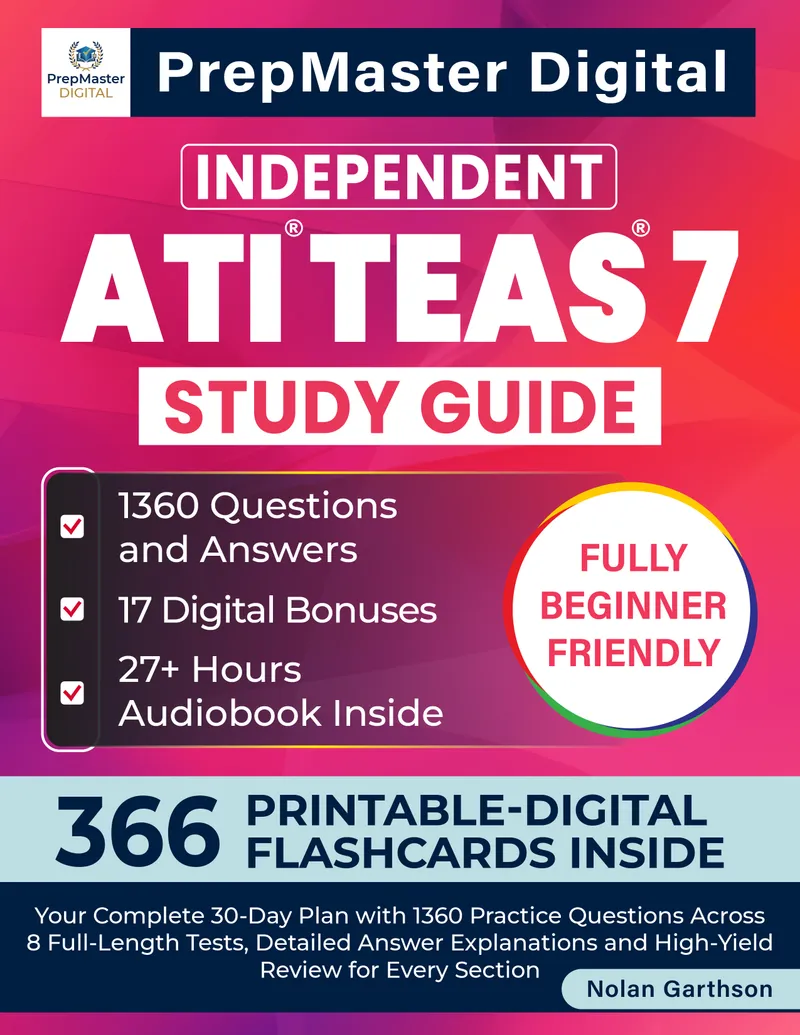
Independent ATI TEAS 7 Study Guide — Complete Digital Edition
Everything you need to raise the score this calculator just gave you: a 30-day plan, full-length practice tests with every answer explained, and review for all four sections.
1,360 practice questions in 8 full-length tests, each answer explained
366 flashcards and a ~27.7-hour audiobook for review on the go
An AI tutor that answers from the guide's chapters (5 free questions)
Instant digital access, yours to keep
Retake Promise: didn't pass? The latest edition of everything, free, for your next attempt